
Articles
To add or not to add: that is the question for your reference spectra prediction databases
Tony Davies,a Wolfgang Robienb and Jeff Seymourc
aExternal Professor, University of Glamorgan, UK, Director, ALIS Ltd, Analytical Laboratory Informatics Solutions
bInstitute for Organic Chemistry, University of Vienna, Austria
cModgraph Consultants, 1 Oakland View, Welwyn AL6 0RJ, UK
Back to basics: observing PLS
A.M.C. Daviesa and Tom Fearnb
aNorwich Near Infrared Consultancy, 75 Intwood Road, Cringleford, Norwich NR4 6AA, UK
bDepartment of Statistical Science, University College London, Gower Street, London, UK
Embedding spectra and structures in your web pages
Tony N. Davies,a Robert J. Lancasterb and Peter Lampenc
aExternal Professor, University of Glamorgan, UK
c/o Waters Informatics, Europaallee 27–29, 50226 Frechen, Germany
bUniversity of West Indies, Mona Campus, Jamaica
cISAS, Institute for Analytical Science, Bunsen-Kirchoff-Strasse 11, 44139 Dortmund, Germany
Back to basics: when you need more than Principal Component Analysis
A.M.C. Daviesa and Tom Fearnb
aNorwich Near Infrared Consultancy, 75 Intwood Road, Cringleford, Norwich NR4 6AA, UK
bDepartment of Statistical Science, University College London, Gower Street, London, UK
Electronic intellectual property
Tony Davies
External Professor, University of Glamorgan, UK
c/o Waters Informatics, Europaallee 27–29, 50226 Frechen, Germany
Back to basics: applications of principal component analysis
A.M.C. Davies
Norwich Near Infrared Consultancy, 75 Intwood Road, Cringleford, Norwich NR4 6AA, UK
Back to the future: total spectroscopic laboratory informatics
Tony Davies
External Professor, University of Glamorgan, UK, c/o Waters Informatics, Europaallee 27–29, 50226 Frechen, Germany
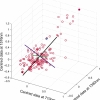
Back to basics: the principles of principal component analysis
PCA is a mathematical method of reorganising information in a data set of samples. It can be used when the set contains information from only a few variables but it becomes more useful when there are large numbers of variables, as in spectroscopic data.
JCAMP-DX to Origin utility Tools for making spectra available to chemometricians
Peter Lampena and Tony Daviesb
aISAS, Institute for Analytical Sciences, Bunsen-Kirchhoff-Str.11, 44139 Dortmund, Germany
bExternal Professor, University of Glamorgan, UK. c/o Waters Informatics, Europaallee 27–29, 50226 Frechen, Germany
Independence rules (or Rules for independence)
A.M.C. Davies
Norwich Near Infrared Consultancy, 75 Intwood Road, Cringleford, Norwich NR4 6AA, UK
Analytical computing survey
Tony Davies
External Professor, University of Glamorgan, UK c/o Waters Informatics, Europaallee 27–29, 50226 Frechen, Germany
Analytical Laboratory Informatics 2004
Tony Davies
External Professor, University of Glamorgan, UK, c/o Creon Lab Control AG, Europaallee 27–29 50226 Frechen, Germany
Estimation of prediction uncertainty for a multivariate calibration model
The goal of building a multivariate calibration model is to predict a chemical or physical property from a set of predictor variables, e.g. analyte concentration or octane number from a near infrared (NIR) spectrum. A good multivariate calibration model should be able to replace the laborious, possibly imprecise reference method. The quality of a model therefore primarily depends on its predictive ability. Other properties such as interpretability of the model coefficients might also be of interest, but here the focus is on the problem of quantifying the predictive ability.
A coloured version of the J-chart or the amc-D J-Chart
A.M.C. Davies
Norwich Near Infrared Consultancy, 75 Intwood Road, Cringleford, Norwich NR4 6AA, UK
AnIMLs in the spectroscopic laboratory?
Tony Davies,a Peter Lampen,b Maren Fiege,c Thorsten Richterc and Thorsten Fröhlichc
aExternal Professor, University of Glamorgan, UK. c/o Creon Lab Control AG, Europaallee 27-29 50226 Frechen, Germany
bISAS, institute for Spectrochemistry and Applied Spectroscopy, Dortmund, Germany
cCreon Lab Control AG, Europaallee 27-29 50226 Frechen, Germany
Eurospec goes live at Achema
The International Spectroscopic Database (IS-DB) went live on 19 May 2003. Following over seven years fighting for funding and receiving the EU EuroSpec grant1 in 2002 the team are pleased to announce that the first version of the international digital archive for spectroscopic data was switched on for data deposition in May.
Olive oil as seen by NMR and chemometrics
Luisa Mannina,a,b Anatoli P. Sobolevb and Annalaura Segreb
aUniversity of Molise, Faculty of Agriculture, 86100 Campobasso, Italy
bInstitute of Chemical Methodologies, CNR, 00016 Monterotondo Staz., Rome, Italy
Doing it faster and smarter (Lesson 6 of Matrix Algebra)
A.M.C.Davies,a and Tom Fearn,b
aNorwich Near Infrared Consultancy, 75 Intwood Road, Cringleford, Norwich NR4 6AA,UK
bDepartment of Statistical Science, University College London, Gower Street, London
Cometh a digital dark age?
Tony Davies
External Professor, University of Glamorgan, UK. c/o Creon Lab Control AG, Europaallee 27-29, 50226 Frechen, Germany
Sorting the wheat from the chaff
Tony M.C. Davies
Norwich Near Infrared Consultancy, 75 Intwood Road, Cringleford, Norwich NR4 6AA,UK
Tom Fearn
Department of Statistical Science, University College London, Gower Street, London